DEA License Lookup by NPI
A DEA license lookup, more precisely a DEA registration lookup, confirms whether a healthcare provider is authorized to …
Everything you need for a DEA license lookup: what a DEA number is, how to verify one, how it connects to the NPI, and how to run a DEA license lookup by name, state, and provider type. Start a lookup above, or jump to any section.
What Is a DEA Number?
A DEA number is a unique identifier assigned by the Drug Enforcement Administration to healthcare providers who are authorized to prescribe, dispense, or administer controlled substances, and it is what any DEA license lookup is ultimately trying to confirm. Where the NPI identifies who a provider is, the DEA number proves they may prescribe Schedule II through V medications.

DEA Number Meaning and Purpose
The DEA number exists to track controlled-substance prescribing authority. Every prescriber who writes for opioids, stimulants, benzodiazepines, or other scheduled drugs must hold an active DEA registration tied to a specific practice location.
DEA Number Format Explained
A DEA number is two letters followed by seven digits, for example AB1234563. The first letter identifies the registrant type; the second letter is usually the first letter of the registrant's last name. The final digit is a check digit.
How the DEA Number Check Digit Works
To validate a DEA number, add the 1st, 3rd, and 5th digits; add the 2nd, 4th, and 6th digits and multiply by two; sum those two results. The last digit of that total must equal the seventh digit of the DEA number. This is how software instantly flags a mistyped or fake DEA number.
What the Letters in a DEA Number Mean
The first letter shows the registrant category: A, B, or F for practitioners, M for mid-level providers such as nurse practitioners and PAs, and others for hospitals, pharmacies, and researchers. An X historically marked buprenorphine (Suboxone) waivered prescribers, covered below.
DEA Number vs NPI at a Glance
It helps to remember that the DEA number and the NPI answer different questions. The NPI is a 10-digit identity number every covered provider holds, while the DEA number is a prescribing credential only controlled-substance prescribers carry. A single provider typically has one NPI for life and one active DEA registration per state where they prescribe.
Who Needs a DEA Number
Any clinician who prescribes, administers, or dispenses controlled substances needs a DEA registration, including physicians, dentists, podiatrists, nurse practitioners, physician assistants, and optometrists in some states. Providers who never handle scheduled drugs, such as many diagnostic radiologists, may practice with only an NPI and no DEA number at all.
How to Look Up a DEA Number by NPI
The most reliable DEA lookup starts from the NPI, because NPPES data is provider-maintained and highly accurate. Confirm identity here first, then verify DEA status through official channels.

Step-by-Step DEA Lookup by NPI
Step 1: enter the provider's NPI in the search above. Step 2: confirm the name, state, specialty, and license number in the NPPES result. Step 3: take that verified legal name and state to the DEA Diversion Control lookup to confirm the DEA registration. Step 4: cross-check the state license with the state board.
NPI to DEA and DEA to NPI Lookup
Working from an NPI to a DEA is the common direction, but you can also go DEA to NPI: once you know the provider's name from the DEA record, search that name here to pull their NPI and full NPPES profile. Both directions rely on the provider's verified identity as the bridge.
Why NPPES Does Not Store DEA Numbers
DEA registration is maintained by the Department of Justice, not CMS, so the NPPES NPI database and the DEA database are separate federal systems. That is why no NPI registry, including this one, can display a DEA number directly. The NPI is the starting point, not the whole answer.
What You Can and Cannot Get From an NPI
From an NPI lookup you get the provider's verified legal name, practice state, specialty, and state license number, everything you need to then confirm a DEA registration through official channels. What you cannot get from the NPI alone is the DEA number itself, its schedules, or its expiration date, because those live only in the DEA system.
How Long a DEA Lookup Takes
In practice the full workflow takes about a minute: a few seconds to pull the NPPES identity here, then a quick check against the DEA registrant lookup and, where needed, the state board. Building this habit into credentialing and pharmacy intake prevents the costly errors that come from skipping verification.
DEA License Verification
A DEA license lookup is only useful if it confirms the registration is real, active, and belongs to the provider you expect, an essential step for credentialing, billing, and pharmacy compliance.

How to Verify a DEA License Is Active
Use the official DEA Diversion Control Registrant lookup to confirm a known DEA number is valid and active. The DEA does not publish a name-searchable database of all registrants, so an active DEA license lookup verifies a number you already have rather than searching by name alone.
DEA License Verification for Credentialing
Credentialing teams treat DEA license verification as a required primary-source check. Starting from the NPI gives you the exact legal name and state needed to validate the DEA record, then documenting both satisfies payer and hospital credentialing standards.
DEA Certificate and Status Checks
A provider's DEA certificate of registration lists the registered address and authorized schedules. Confirming the certificate status (active vs expired) and that the address matches the practice location is part of a complete DEA license lookup.
DEA License Lookup by Name
Many searches begin with a provider's name rather than a number. Because the DEA has no public name search, a DEA license lookup by name works best in two steps: identify the provider here, then verify their DEA record.
How to Do a DEA License Lookup by Name
Enter the provider's last name and state in the search above to confirm their identity and NPI. That verified name is what you carry into DEA verification, since the official registration lookup expects the number tied to that individual, not a name search.
Doctor and Physician DEA Lookup
A doctor DEA lookup or physician DEA number lookup follows the same flow: confirm the physician in NPPES, then validate their DEA registration and schedules. This is the standard way pharmacies and billing teams check a prescriber.
Prescriber DEA Lookup
Any prescriber, MD, DO, NP, PA, dentist, or podiatrist, can be checked this way. Confirm the prescriber's identity and specialty first, which also tells you whether a DEA registration is even expected for their scope of practice.
DEA License Lookup by State
DEA registration is location-specific, and controlled-substance authority is also governed by state law, so state context matters for every DEA lookup.
How State DEA Lookups Work
The federal DEA registration is national, but a provider must also hold a valid state license (and, in some states, a separate state controlled-substance registration) for the state where they practice. Confirm the practice state in NPPES before verifying.
Popular State DEA Lookups
Common searches include DEA lookup Florida, Texas, California, Maryland, Ohio, Illinois, New York, Virginia, Georgia, and Pennsylvania. For each, identify the provider and practice state here, then verify the DEA number and the matching state license.
State Medical Board and Controlled-Substance Verification
Several states run their own controlled-substance registration on top of the federal DEA. Always pair the DEA check with the relevant state medical, nursing, dental, or pharmacy board to confirm active licensure in that state.
DEA Lookup by Provider Type
Different provider types hold DEA registrations under different rules. Here is how DEA lookups work across the most searched categories.

Physician DEA Number Lookup
Physicians (MD/DO) who prescribe controlled substances hold an individual DEA registration. Confirm the physician's NPI and specialty, then verify their DEA number and authorized schedules.
Nurse Practitioner and PA DEA Numbers
Nurse practitioners and physician assistants are mid-level prescribers, their DEA numbers usually begin with the letter M. In many states their controlled-substance prescribing is tied to state scope-of-practice rules and, sometimes, physician collaboration.
Pharmacy DEA Lookup
Pharmacies hold their own institutional DEA registration to dispense controlled substances. A pharmacy DEA lookup verifies the dispensing site, separate from the individual pharmacist and from the prescriber on the prescription.
Dentist DEA Number Lookup
Dentists who prescribe pain medication or sedatives carry individual DEA registrations. A dentist DEA number lookup confirms both their dental license and controlled-substance authority.
Veterinarian DEA Number Lookup
Veterinarians also register with the DEA to prescribe and administer controlled substances to animals. Note that veterinarians are not in NPPES, since the NPI covers human healthcare, so a vet DEA lookup relies on state veterinary boards and DEA directly.
Hospital and Institutional DEA Numbers
Hospitals and clinics may use an institutional DEA registration, sometimes with internal suffix codes for individual practitioners operating under the facility's registration. Confirm whether a prescriber uses their own DEA or an institutional one.
DEA Expiration Date Lookup
A DEA registration is only valid while active, so checking the expiration date is a key part of verification.
How to Look Up a DEA Expiration Date
DEA expiration dates are shown on the provider's DEA certificate and confirmed through the DEA registrant lookup, not in NPPES. Ask the provider for their certificate or verify the active status directly with the DEA when an exact date is required.
DEA Renewal and Expiration Rules
DEA registrations are issued for a three-year term and must be renewed before they lapse. An expired DEA registration means the provider may not prescribe controlled substances until it is renewed, which is why expiration checks matter for pharmacies and billers.
How to Get a DEA Number
Providers who need to prescribe controlled substances apply for a DEA registration directly with the Drug Enforcement Administration. Understanding the process helps when you are verifying a new prescriber whose registration is still pending.

The DEA Registration Application
Applicants complete DEA Form 224 (for practitioners) online through the DEA Diversion Control website. The application asks for the provider's identity, state license, practice address, and the drug schedules they intend to handle. Approval typically takes several weeks.
DEA Application Status Lookup
Applicants can check their DEA application status through the DEA's online portal using their tracking details. Until the registration is issued and active, the provider cannot legally prescribe controlled substances, even if they already hold an NPI and state license.
State License First, Then DEA
A valid state professional license is a prerequisite for DEA registration. That is why the verification order matters: confirm identity and license in NPPES and with the state board, then confirm the DEA registration built on top of them.
DEA Registration Fees and Renewal
Unlike the NPI, which is free and permanent, a DEA registration carries a fee and must be renewed on a fixed cycle. These differences often surprise providers comparing the two credentials.
Registration Fee and Term
Practitioner DEA registrations are issued for a three-year term and require a registration fee set by the DEA. The NPI, by contrast, is free for life, which is one reason the two identifiers are managed and verified so differently.
Renewing a DEA Registration
Providers must renew before the expiration date to avoid a lapse in prescribing authority. A lapsed registration means the provider cannot prescribe controlled substances until it is reinstated, so renewal tracking is a routine part of credentialing.
What Happens If a DEA Registration Lapses
If a DEA registration expires, any controlled-substance prescriptions written after the lapse are invalid. Pharmacies verifying an expired registration should not fill those prescriptions, which is why expiration and renewal checks are built into pharmacy compliance.
DEA Registration Rules: One Per Location
DEA registration is tied to a specific registered address, which shapes how multi-site and relocating providers manage their credentials.
A Separate Registration Per State Location
Generally, a practitioner needs a separate DEA registration for each state where they maintain a location and prescribe controlled substances. A provider practicing in two states usually holds two DEA registrations, each tied to that state's license.
DEA Numbers Are Not Transferable
A DEA number belongs to the registrant at the registered address and cannot be transferred to another provider or sold. When a provider moves, they update the registered address with the DEA rather than obtaining a brand-new number for a simple relocation within the same state.
Address Changes and Verification
Because the registered address is part of the DEA record, a mismatch between the practice address in NPPES and the DEA certificate can signal an outdated registration. Confirm the current registered address during verification, especially for recently relocated providers.
Electronic Prescribing of Controlled Substances (EPCS)
Most controlled-substance prescriptions are now transmitted electronically, and the DEA number is central to how those e-prescriptions are authorized and audited.
What EPCS Is
EPCS is the electronic prescribing of Schedule II through V medications directly from a prescriber's software to the pharmacy. It requires identity-proofing and two-factor authentication tied to the prescriber's DEA registration.
Why the DEA Number Anchors EPCS
Every EPCS transaction is linked to the prescriber's DEA number, which authorizes the controlled-substance order, while the NPI identifies the provider for billing and routing. The two identifiers work together on a single electronic prescription.
EPCS Mandates
Federal and many state rules now require EPCS for controlled substances, particularly under measures aimed at reducing opioid diversion. Verifying an active DEA registration is a prerequisite for a prescriber to participate in EPCS at all.
The DEA Number on a Prescription
When you see a controlled-substance prescription, the DEA number is what makes it legally valid. Knowing what pharmacies check clarifies why verification matters so much.
Required Elements of a Controlled-Substance Prescription
A valid controlled-substance prescription includes the prescriber's name, address, DEA number, the drug and quantity, and the date. The DEA number authorizes the controlled substance, while the NPI may also appear for identification and billing.
The Pharmacist's Corresponding Responsibility
Pharmacists share legal responsibility for ensuring a controlled-substance prescription is legitimate. That duty, known as corresponding responsibility, includes validating the prescriber's DEA number and watching for red flags before dispensing.
Detecting Invalid or Fraudulent Numbers
The DEA check digit is the first automated screen against forged prescriptions, and active-status verification is the second. Together they help pharmacies stop prescriptions written under invalid, expired, or stolen DEA registrations.
Government and Military Provider Exemptions
Some providers handle controlled substances under a government registration rather than an individual one, which changes how you verify them.
VA, PHS, and Military Providers
Clinicians employed by the Department of Veterans Affairs, the Public Health Service, or the military may prescribe under an official government DEA registration tied to their facility, rather than a personal registration. Verification for these providers runs through the employing agency.
Why Some Providers Have No Personal DEA
A government-employed prescriber may legitimately lack a personal DEA number because they prescribe under the agency's registration. Confirming employment context through NPPES and the facility prevents mistaking this for a missing or invalid registration.
The X-Waiver, Suboxone, and X DEA Numbers
Searches for an X DEA number or Suboxone DEA lookup relate to buprenorphine prescribing for opioid use disorder, an area that changed significantly in 2023.
What Was the X DEA Number?
Historically, providers needed a special DEA X-waiver (a DEA number beginning with X) to prescribe buprenorphine products such as Suboxone for addiction treatment. The X number signaled that added authorization.
DEA X-Waiver After the MAT Act
The Consolidated Appropriations Act of 2023 (the MAT Act) eliminated the X-waiver requirement. Now any prescriber with a standard DEA registration may prescribe buprenorphine for opioid use disorder, subject to a one-time training requirement, so new X numbers are no longer issued.
NPI vs DEA Number
The NPI and DEA number are often confused because both identify providers, but they serve completely different purposes.

| Feature | NPI | DEA Number |
|---|---|---|
| Issued by | CMS (NPPES) | Drug Enforcement Administration |
| Format | 10 digits | 2 letters + 7 digits |
| Purpose | Identify the provider on all transactions | Authorize controlled-substance prescribing |
| Who has one | All HIPAA-covered providers | Only controlled-substance prescribers |
| Public database | Yes, fully searchable | Verify a known number only |
Do All Providers Have a DEA Number?
No. A radiologist, pathologist, or purely diagnostic provider may hold an NPI but no DEA number if they never prescribe controlled substances. Every controlled-substance prescriber, however, needs both.
Why Both Are Verified Together
Credentialing and pharmacy workflows check the NPI to confirm identity and the DEA to confirm prescribing authority. Together they answer "who is this provider?" and "may they prescribe this drug?"
DEA Schedules and Prescribing Authority
DEA registrations are tied to specific controlled-substance schedules, which determine what a provider may prescribe.

Controlled Substance Schedules II to V
Schedule II drugs (such as oxycodone, morphine, and Adderall) carry the strictest controls, with tight limits on quantity and refills. Schedules III through V allow progressively more flexibility. A DEA registration specifies which schedules the provider may handle.
Confirming Schedule-Level Authority
To confirm a provider can prescribe a specific controlled substance, verify both that the DEA registration is active and that it covers the relevant schedule. NPPES does not carry schedule detail, so this is confirmed with the DEA.
Schedule Examples by Drug Class
Schedule II covers high-abuse-potential drugs such as oxycodone, fentanyl, morphine, and Adderall. Schedule III includes products like certain testosterone and moderate-strength combinations, Schedule IV covers many benzodiazepines and sleep aids, and Schedule V covers low-strength cough and antidiarrheal preparations. A provider's authority can vary by schedule, so match the drug to the registration.
Why Schedules Affect Verification
A prescriber may hold an active DEA registration yet still lack authority for a particular schedule, or a state may restrict a mid-level provider's controlled-substance scope. That is why schedule-level confirmation, not just an active-status check, is part of thorough DEA verification for high-risk prescriptions.
Why Credentialing Teams Cross-Check DEA and NPI
Hospitals, payers, and pharmacy benefit managers routinely verify both NPI and DEA credentials, and the NPI is the most reliable place to start.
Provider Onboarding and Re-Credentialing
During onboarding and periodic re-credentialing, staff confirm identity via NPPES, then verify DEA registration, state licensure, and board certification. Because providers maintain their own NPPES record under federal mandate, it is a trusted identity source.
Preventing Prescription Fraud
Verifying DEA numbers helps pharmacies and payers catch invalid or borrowed registrations before a controlled-substance prescription is filled. The check-digit test and active-status verification together reduce fraud risk.
Free DEA Verification Resources
Several free and paid resources support DEA verification once you have confirmed provider identity here.
Official DEA Diversion Control Lookup
The primary free resource is the DEA Diversion Control Division at deadiversion.usdoj.gov, where you validate a known DEA registration number. This is the authoritative source for DEA status.
State PDMPs and NCPDP Data
State prescription drug monitoring programs cross-reference DEA numbers against prescribing activity, and the NCPDP maintains pharmacy-specific data. These complement, but do not replace, the official DEA lookup.
Enterprise Credentialing Platforms
Large health systems use paid platforms such as CAQH ProView and similar services for automated, batch DEA and license verification integrated with NPI lookup. These are aimed at high-volume credentialing operations.
DEA Registrant Types and Category Letters
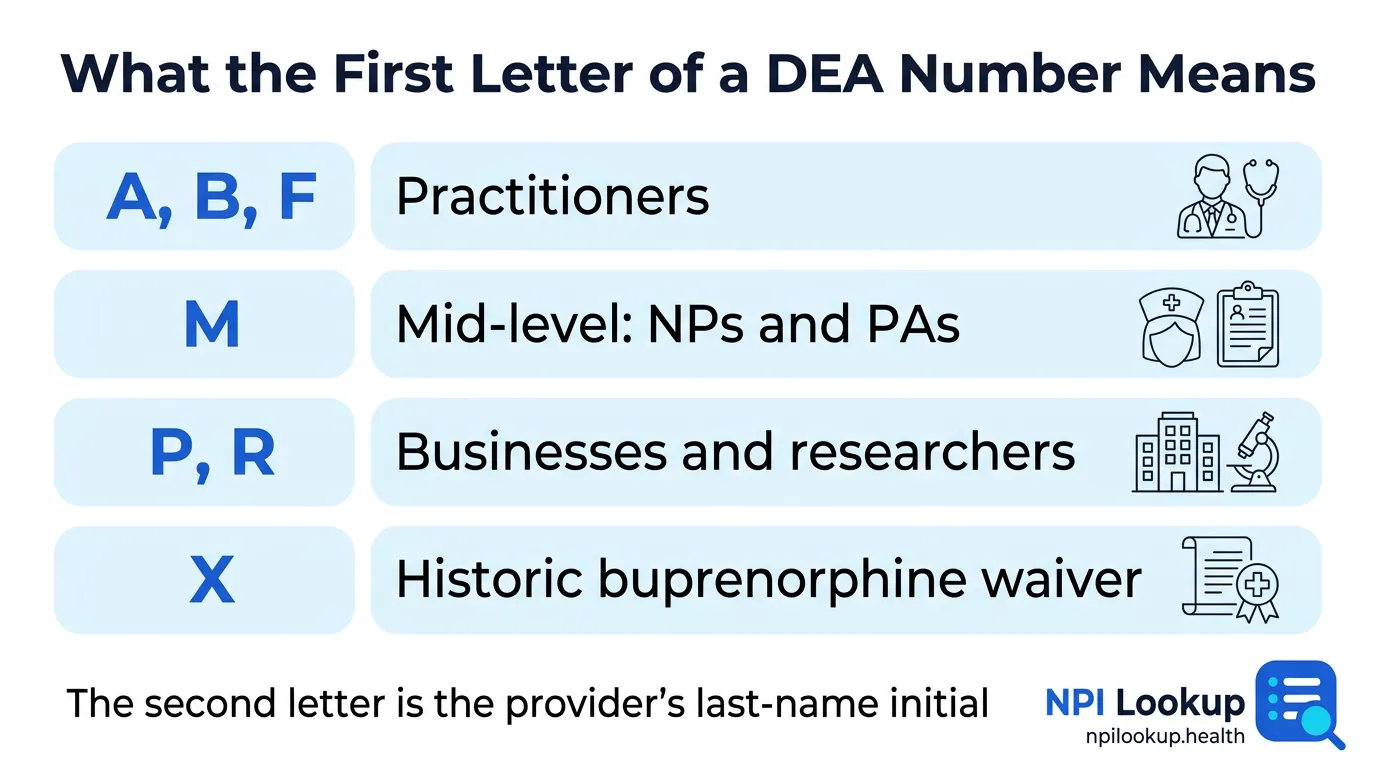
The first letter of a DEA number is not random, it encodes the registrant category. Reading it correctly tells you what kind of provider or entity the registration belongs to, which is a useful sanity check during any DEA lookup.
What the First Letter Tells You
Practitioner registrations most often begin with A, B, or F. Mid-level providers such as nurse practitioners and physician assistants use M. Other letters cover hospitals, pharmacies, teaching institutions, manufacturers, distributors, and researchers.
| First letter | Registrant category |
|---|---|
| A, B, F | Practitioners (physicians, dentists, and similar prescribers) |
| G | Certain government or contractor registrations |
| M | Mid-level practitioners (NPs, PAs, and similar) |
| P, R | Manufacturers, distributors, researchers, and analytical labs |
| X | Historic buprenorphine (Suboxone) waiver registrations |
Why the Second Letter Matters
The second letter is normally the first letter of the registrant's last name (or, for businesses, the first letter of the organization name). If that letter does not match the provider you looked up in NPPES, treat the DEA number as suspect and re-verify it.
Institutional DEA Numbers and Suffix Codes
Not every prescriber has their own individual DEA registration. Many hospital-based providers prescribe under their institution's DEA number using an internal suffix, and knowing this prevents confusion during verification.

How Institutional DEA Registration Works
A hospital or clinic holds a single institutional DEA registration for its site. Residents, interns, and some staff prescribe under that registration rather than obtaining their own, which is common in teaching hospitals.
Reading a DEA Suffix Code
When a provider prescribes under an institutional registration, the DEA number is written with a hyphenated suffix that identifies the individual within the institution. The base number identifies the facility; the suffix identifies the practitioner.
Individual vs Institutional Registration
Always confirm whether a prescriber is using their own DEA number or an institutional one, because the verification path differs. For institutional suffixes, verification runs through the hospital's DEA coordinator rather than a standalone registrant record.
DEA Number vs State Controlled Substance Registration
A federal DEA registration is only half of the controlled-substance picture in many states. Several states require a separate state controlled substance registration (CSR) on top of the DEA number.

What Is a State CSR?
A state controlled substance registration is a state-issued permit to handle scheduled drugs within that state. States such as Texas, New York, and others operate their own CSR programs alongside the federal DEA registration.
Verifying Both Federal and State Authority
To fully confirm a provider can prescribe controlled substances in a given state, verify the federal DEA registration and, where required, the state CSR through the state board or health department. A valid DEA number alone may not be sufficient in CSR states.
Why This Matters for Pharmacies
Pharmacies dispensing in CSR states must confirm both credentials before filling. A prescriber with a valid DEA number but a lapsed state CSR may not be authorized to prescribe controlled substances in that state.
DEA Lookup for Telehealth and Multi-State Prescribing
Telehealth has made DEA verification more complex, because a provider may treat patients across state lines. Confirming where a prescriber is registered and licensed is essential for compliant remote prescribing.
Controlled Substances via Telehealth
Federal rules govern when controlled substances can be prescribed through telehealth, and those rules have evolved in recent years. Verifying the prescriber's active DEA registration is the baseline requirement before any controlled-substance telehealth prescription.
Multi-State Practice and DEA Registration
A provider practicing in several states generally needs a DEA registration for each state where they maintain a registered location, plus the corresponding state license. Use NPPES to confirm each practice state, then verify the matching DEA and license for that state.
How to Read Your DEA Lookup Results
When you search an NPI here, the result gives you the identity data that anchors DEA verification. Knowing which fields matter keeps the workflow fast and accurate.
Fields That Support DEA Verification
Focus on the legal name, practice state, primary taxonomy, and state license number. These are exactly the details you carry into the official DEA registrant lookup and the state board verification.
Matching the Result to the Right Provider
For common names, use the city, taxonomy, and license number to confirm you have the correct individual before verifying their DEA registration. Verifying the wrong provider is a frequent and avoidable credentialing error.
When a Provider Has No Expected DEA
If the taxonomy indicates a non-prescribing specialty, such as diagnostic radiology or pathology, the provider may legitimately have no DEA registration. The NPPES result helps you set that expectation before you search for a DEA number that may not exist.
DEA License Lookup by State: All 50 States
Because DEA authority pairs with a state license (and sometimes a state CSR), state context is part of every DEA lookup. Confirm the provider's practice state in NPPES here, then verify the DEA registration and the matching state credential. The workflow is the same in every state:
| Region | States (verify DEA + state license for each) |
|---|---|
| Northeast | Connecticut, Maine, Massachusetts, New Hampshire, New Jersey, New York, Pennsylvania, Rhode Island, Vermont |
| Southeast | Alabama, Florida, Georgia, Kentucky, Mississippi, North Carolina, South Carolina, Tennessee, Virginia, West Virginia |
| Midwest | Illinois, Indiana, Iowa, Kansas, Michigan, Minnesota, Missouri, Nebraska, North Dakota, Ohio, South Dakota, Wisconsin |
| Southwest | Arizona, New Mexico, Oklahoma, Texas |
| West | Alaska, California, Colorado, Hawaii, Idaho, Montana, Nevada, Oregon, Utah, Washington, Wyoming |
| Other | Delaware, Maryland, Arkansas, Louisiana, plus Washington DC |
High-Demand State DEA Lookups
The most searched state DEA lookups include Florida, Texas, California, Maryland, Ohio, Illinois, New York, and Virginia. For each, the steps are identical: identify the provider and practice state here, then verify the DEA registration and state license (and CSR where required).
State Board Verification Links
Each state medical, nursing, dental, and pharmacy board runs its own license verification portal. Pairing the state board check with the federal DEA lookup gives you complete, state-specific confirmation of a provider's prescribing authority.
Common DEA Lookup Problems and Fixes
Most failed DEA lookups trace back to a small set of avoidable issues. Work through these before assuming a provider has no registration.
The DEA Number Fails the Check Digit
If a DEA number does not pass the check-digit test, it was likely mistyped. Re-enter it carefully, and confirm the two letters against the registrant type and the provider's last name before flagging it as invalid.
Cannot Find the Provider to Start
If you cannot locate the provider in NPPES, try the last name alone, remove or change the state, or search a former name. Once you confirm identity here, the DEA verification step becomes straightforward.
Name Does Not Match the DEA Record
A mismatch between the NPPES name and the DEA record can indicate a name change, an institutional registration, or an error. Investigate the discrepancy rather than proceeding, since accurate matching is essential for credentialing.
History of the DEA Registration System
Understanding where the DEA number comes from explains why it is structured and verified the way it is today.
The Controlled Substances Act
The DEA registration system stems from the Controlled Substances Act of 1970, which created a federal framework for regulating scheduled drugs. The DEA number became the mechanism for tracking who may handle those substances.
Why the Number Is Structured This Way
The two-letter, seven-digit format with an embedded check digit was designed so pharmacies and software could validate a number quickly, long before online databases existed. That built-in validation is still the first line of defense against fraud.
How DEA Verification Evolved
Verification has moved from paper certificates to online registrant lookups and automated credentialing platforms. The NPI-to-DEA workflow reflects that evolution, using the modern NPPES database as the reliable identity anchor.
Glossary of DEA and NPI Terms
| Term | Meaning |
|---|---|
| DEA number | Two letters + seven digits authorizing controlled-substance handling |
| NPI | 10-digit National Provider Identifier issued by CMS |
| NPPES | The CMS database of all NPI records |
| Check digit | The 7th DEA digit used to validate the number |
| Schedule II to V | Controlled-substance categories by abuse potential |
| CSR | State Controlled Substance Registration, in addition to the DEA |
| Institutional DEA | A facility registration prescribers use with a suffix code |
| X-waiver | Former buprenorphine authorization, eliminated by the 2023 MAT Act |
| PDMP | State Prescription Drug Monitoring Program |
| Diversion Control | The DEA division that runs official DEA verification |
DEA Number Security and Proper Use
DEA numbers are sensitive credentials, and both the NPI and DEA should be used only for legitimate healthcare purposes.
Protecting DEA Numbers
Because DEA numbers authorize controlled-substance prescribing, they should be safeguarded like any credential and never shared or reused improperly. Verification should rely on official sources rather than stored copies.
Legitimate Uses Only
This tool displays only CMS NPPES data and never DEA numbers. Use it for provider identity verification, credentialing, and billing, not for law enforcement, legal proceedings, or surveillance. For authoritative DEA verification, always use deadiversion.usdoj.gov.
Frequently Asked Questions
Common questions about DEA license lookup by NPI, DEA number format and verification, expiration dates, and how the DEA number relates to the NPI. Click any question to expand it.
How do I do a DEA license lookup?
Start with the provider's name or NPI, confirm their identity and state through NPPES here, then verify the DEA registration number itself at the DEA Diversion Control Division's official Registrant lookup (deadiversion.usdoj.gov). A DEA license lookup is really a two-step process: confirm identity, then confirm registration.
Can I find a DEA number from an NPI number?
Not directly. The NPPES registry does not store DEA numbers. Use the NPI to confirm provider identity in NPPES, then verify their DEA registration separately at the DEA Diversion Control Division's official website (deadiversion.usdoj.gov).
How do I look up a DEA number by NPI?
Enter the NPI in the search above to confirm the provider's name, state, and specialty, then take that verified identity to the DEA Diversion Control lookup to validate their DEA registration. The NPI-to-DEA workflow uses NPPES identity as the bridge.
Is this DEA lookup tool free?
Yes, this tool is completely free. It pulls data from the public CMS NPPES API at no cost. DEA verification itself is also free through the DEA's official website at deadiversion.usdoj.gov.
Does the NPPES registry include DEA numbers?
No. The NPPES registry contains NPI numbers, provider names, specialties, addresses, and state license numbers, but not DEA registration numbers. DEA data is maintained separately by the Drug Enforcement Administration.
How do I verify a provider's DEA license is active?
Visit deadiversion.usdoj.gov and use the online DEA Registrant lookup. Enter the DEA number to confirm it is active and belongs to the provider. For batch verification, enterprise credentialing platforms offer automated DEA validation.
What is the format of a DEA number?
A DEA number is two letters followed by seven digits (e.g., AB1234563). The first letter indicates registrant type, the second letter is usually the provider's last-name initial, and the seventh digit is a check digit used to validate the number.
How does the DEA number check digit work?
Add the 1st, 3rd, and 5th digits. Separately add the 2nd, 4th, and 6th digits and multiply by two. Add those two results, and the last digit of the total must match the 7th digit of the DEA number. This catches typos and invalid numbers.
How do I look up a DEA expiration date?
DEA expiration dates appear on the provider's DEA certificate and are confirmed through the DEA registrant lookup, not in NPPES. DEA registrations run for three years and must be renewed before they lapse.
Can I look up a DEA number by name?
The DEA does not offer a public name search. Instead, identify the provider by name in NPPES here to get their NPI and verified identity, then validate their DEA registration number through the official DEA lookup.
How do I look up a DEA license by state (Florida, Texas, California)?
Confirm the provider and their practice state in NPPES here, then verify their DEA registration and the matching state license. Some states also require a separate state controlled-substance registration in addition to the federal DEA number.
Do nurse practitioners and PAs have DEA numbers?
Yes. Mid-level prescribers such as nurse practitioners and physician assistants have DEA numbers that typically begin with the letter M, subject to state scope-of-practice rules for controlled substances.
What is an X DEA number for Suboxone?
Historically, prescribing buprenorphine (Suboxone) for opioid use disorder required a DEA X-waiver, shown as a DEA number starting with X. The 2023 MAT Act eliminated the X-waiver, so any provider with a standard DEA registration may now prescribe it.
Do all providers have a DEA number?
No. Only providers who prescribe, administer, or dispense controlled substances need a DEA number. A provider such as a radiologist or pathologist may have an NPI but no DEA registration.
Can pharmacies look up a prescriber's DEA number?
Pharmacies verify DEA numbers through the DEA Diversion Control system, and most pharmacy management systems check them automatically when processing controlled-substance prescriptions. The NPI on the prescription is used separately for identity and billing.
How do I get a DEA number?
Apply directly with the DEA using Form 224 through the DEA Diversion Control website. You must already hold a valid state license. Registration carries a fee, is issued for a three-year term, and typically takes several weeks to process. This tool does not issue DEA numbers; it verifies provider identity.
How much does a DEA registration cost and how long is it valid?
A practitioner DEA registration is issued for a three-year term and requires a registration fee set by the DEA. Unlike the NPI, which is free and permanent, the DEA registration must be renewed before it expires to keep controlled-substance prescribing authority active.
Can a DEA number be transferred to another provider?
No. A DEA number belongs to the registrant at the registered address and cannot be transferred or sold. When a provider relocates, they update the registered address with the DEA rather than passing the number to someone else.
Do providers need a separate DEA number for each state?
Generally yes. A practitioner needs a DEA registration for each state where they maintain a location and prescribe controlled substances, paired with a valid license in that state and, where required, a state controlled substance registration.
What is a state controlled substance registration (CSR)?
Some states require a separate state-issued permit to handle scheduled drugs in addition to the federal DEA registration. In CSR states, verify both the DEA number and the state CSR to confirm a provider can prescribe controlled substances there.
What is EPCS?
EPCS is the Electronic Prescribing of Controlled Substances. It transmits Schedule II to V prescriptions electronically and requires identity-proofing and two-factor authentication tied to the prescriber's active DEA registration. Many states now mandate EPCS.
Where does the DEA number appear on a prescription?
On a controlled-substance prescription the DEA number identifies the prescriber's authority to order the drug, alongside their name, address, and the medication details. Pharmacists validate the DEA number as part of their corresponding responsibility before dispensing.
Why does a provider have no DEA number?
Some providers legitimately have no DEA number. Non-prescribing specialists such as many radiologists and pathologists do not need one, and government or military providers may prescribe under an agency registration rather than a personal DEA number.
Is this tool affiliated with the DEA or CMS?
No. This is an independent tool that uses the public NPPES API maintained by CMS. It is not affiliated with, endorsed by, or connected to the DEA, CMS, HHS, or any US government agency.
Other Lookup Tools
DEA License Lookup by NPI
Verify DEA registration information and prescribing authority using NPI.
Look up DEA →PECOS Medicare Enrollment
Check Medicare enrollment and PECOS status for any provider by NPI.
Check PECOS →PTAN Lookup by NPI
Find Provider Transaction Access Numbers for Medicare billing setup.
Find PTAN →Tax ID Lookup by NPI
Cross-reference EIN and tax identification with NPI records.
Look up Tax ID →CAQH Lookup by NPI
Guide to accessing CAQH ProView credentialing data using NPI numbers.
CAQH guide →Medicaid Provider Lookup
Verify Medicaid provider enrollment status across all US states.
Medicaid lookup →